
- All
- Product Name
- Product Keyword
- Product Model
- Product Summary
- Product Description
- Multi Field Search
English


| Quantity: | |
|---|---|


JunHe
Square mesh fiberglass grating represents a molded composite flooring solution designed for industrial platforms, walkways, and drainage covers. Constructed from continuous glass fiber strands impregnated with thermosetting resin, this grating delivers structural performance with approximately one-third the weight of equivalent steel grating. The square mesh pattern creates uniform load distribution across the panel surface, while the open grid design allows light, air, and liquid to pass through. JUNHE fiberglass grating panels are produced through a molded manufacturing process, resulting in integral construction without welded joints or connection points that can corrode over time.
Commercial facility managers and engineering procurement teams specify fiberglass grating for environments where steel alternatives experience accelerated corrosion. The material composition eliminates the need for periodic painting or galvanizing maintenance that steel grating requires throughout its service life. Standard panels are available in three thickness options to accommodate different load requirements, from pedestrian walkways to heavy-duty industrial platforms.
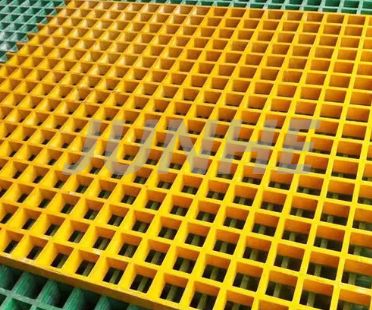
Parameter | Standard Value | Customizable Range |
|---|---|---|
Length | 1200 mm | 500 - 3000 mm |
Width | 600 mm, 900 mm | 300 - 1500 mm |
Thickness | 30 mm, 38 mm, 50 mm | - |
Parameter | Value Range |
|---|---|
Uniform Load | 3000 - 5000 N/m² |
Concentrated Load (single point) | 1000 - 2000 N |
Note: Load-bearing values vary by panel thickness and support span configuration.
Parameter | Standard Values |
|---|---|
Crossbar Spacing | 30 mm, 40 mm |
Longitudinal Bar Spacing | 40 mm, 50 mm |
Property | Specification |
|---|---|
Glass Fiber Content | ≥ 70% by weight |
Resin Type | Unsaturated polyester resin, vinyl ester resin |
Tensile Strength | ≥ 500 MPa |
Bending Strength | ≥ 700 MPa |
Treatment Type | Specification |
|---|---|
Anti-slip Surface | Granular surface layer, friction coefficient ≥ 0.6 |
Anti-corrosion Coating | Salt spray test duration ≥ 1000 hours |
Property | Specification |
|---|---|
Fire Retardant Grade | UL94-V0 |
The structural performance of fiberglass grating derives from continuous glass fiber strands arranged in bi-directional orientation. The glass fiber content accounts for no less than 70% of the total material weight, providing the primary tensile and bending strength of the composite panel. Fibers are distributed throughout both the load-bearing bars and cross members, creating uniform mechanical properties across the entire panel surface.
The molded manufacturing process impregnates glass fibers with resin under controlled pressure and temperature conditions. This method ensures complete fiber wet-out and consistent resin-to-fiber ratio throughout the panel cross-section. Unlike pultruded grating profiles that are assembled mechanically, molded grating forms a single integrated structure with no separate connection points between bearing bars and crossbars.
Two resin systems are available to match different environmental requirements:
Unsaturated polyester resin provides baseline corrosion resistance for general industrial applications. This resin system offers cost-effective performance for indoor platforms, commercial walkways, and drainage applications where exposure to concentrated chemicals is limited.
Vinyl ester resin delivers enhanced chemical resistance for more aggressive environments. This resin formulation is specified for wastewater treatment facilities, chemical processing plants, and marine applications where exposure to acids, alkalis, and saltwater is expected. Vinyl ester resin panels maintain structural properties after extended exposure to corrosive substances that would degrade standard polyester resin.
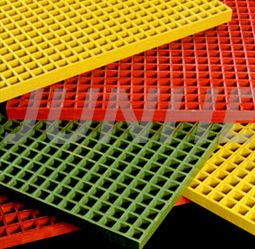
The square mesh configuration distributes applied loads across multiple bearing bars, reducing stress concentrations at any single point. Uniform load capacity ranges from 3000 to 5000 N/m² depending on panel thickness and support spacing. Concentrated load capacity reaches 1000 to 2000 N at single-point contact, suitable for pedestrian traffic and equipment placement.
Bending strength measures no less than 700 MPa, providing deflection resistance under design loads. The bi-directional fiber arrangement ensures that panels exhibit similar strength properties in both length and width directions, allowing flexibility in installation orientation. Tensile strength of no less than 500 MPa contributes to the material's resistance to impact and dynamic loading conditions.
Fiberglass grating does not rust or oxidize when exposed to moisture, salt spray, or chemical vapors. Panels with anti-corrosion coating maintain structural integrity after 1000 hours of salt spray testing per standard test protocols. This corrosion resistance eliminates the need for protective coatings that require periodic reapplication on steel grating alternatives.
Vinyl ester resin panels are compatible with a range of chemical substances commonly found in industrial environments. The resin matrix acts as a barrier against chemical penetration, preventing the fiber reinforcement from degradation. Facility operators in chemical processing, food and beverage, and water treatment sectors specify fiberglass grating to reduce replacement frequency caused by corrosion-related failure.
Fiberglass grating panels achieve UL94-V0 flame retardant classification, indicating self-extinguishing performance when exposed to flame sources. The fire retardant formulation is integrated into the resin matrix during manufacturing, rather than applied as a surface coating that can wear off over time.
This fire performance rating makes fiberglass grating suitable for installation in industrial facilities where fire safety codes require non-combustible or self-extinguishing building materials. The material does not contribute fuel to fire propagation and does not produce molten drips when exposed to high temperatures.
The grating surface incorporates a granular anti-slip layer that produces a friction coefficient of at least 0.6. This surface texture is molded into the panel during production, creating an integral traction layer that does not peel or wear away under regular foot traffic.
Anti-slip performance remains consistent across the full service life of the grating, unlike painted or coated steel surfaces that degrade with wear. This characteristic reduces slip-and-fall risks in industrial walkways, stair treads, and platform access points where wet or oily conditions may be present.
Manufacturing facilities and production plants use fiberglass grating for elevated operator platforms, equipment access walkways, and mezzanine flooring. The material's strength-to-weight ratio allows installation on existing support structures without requiring structural reinforcement that steel grating would demand.
In chemical processing plants and pharmaceutical manufacturing facilities, fiberglass grating provides a flooring solution that withstands exposure to process chemicals and regular wash-down procedures. The open grid design allows spilled liquids and process debris to fall through the walking surface, reducing slip hazards and simplifying facility cleaning routines.
Wastewater treatment plants install fiberglass grating for tank access walkways, clarifier platforms, and pump station flooring. These environments present continuous exposure to moisture, hydrogen sulfide gas, and varying pH levels that accelerate corrosion in metal grating alternatives.
Both unsaturated polyester and vinyl ester resin options are used in wastewater applications, with selection based on the specific chemical profile of the facility. Grating panels require no painting or corrosion protection maintenance throughout their service life, reducing maintenance labor costs for facility operations teams.
Electrical substations and power generation facilities use fiberglass grating for maintenance walkways and equipment access platforms. The material's electrical non-conductivity provides an additional safety factor for personnel working around high-voltage equipment.
Lightweight panels simplify installation and relocation of temporary access routes during substation maintenance projects. The corrosion-resistant properties ensure that grating installed in outdoor substations maintains structural performance through seasonal temperature variations and precipitation exposure.
Offshore platforms, ship decks, and coastal facilities specify fiberglass grating for walkway applications where saltwater exposure is constant. The material resists saltwater corrosion and UV degradation without requiring galvanizing or protective coating systems.
Marine-grade fiberglass grating withstands wave splash exposure and humid coastal environments that cause rapid rust formation on steel grating. The lightweight properties reduce dead load on offshore structures, an important consideration for platform design and weight distribution calculations.
Architects and building designers incorporate fiberglass grating into stair treads for industrial buildings, parking structures, and public access facilities. The anti-slip surface provides traction in outdoor stairwells where rain and snow accumulation create slip hazards.
Fiberglass stair treads install faster than steel alternatives due to their lower weight, reducing installation labor costs for construction projects. The material's corrosion resistance ensures that exterior stair treads maintain appearance and performance without requiring periodic repainting or rust removal.
Fiberglass grating panels install using standard fastening methods appropriate for the support structure. Panel weight of approximately one-third that of equivalent steel grating allows two-person installation teams to handle and position panels without heavy lifting equipment. This weight reduction translates to measurable labor cost savings during new construction and facility retrofit projects.
Panels can be cut on-site to fit irregular openings using standard power tools equipped with diamond or abrasive cutting blades. Fabrication dust generated during cutting should be controlled with appropriate personal protective equipment and dust collection methods.
Routine maintenance consists of periodic cleaning with water and mild detergent to remove surface dirt and debris. No corrosion protection maintenance is required. Panels that sustain damage from impact or excessive load can be replaced individually without requiring removal of adjacent grating sections.
Standard panel dimensions include 1200 mm length with 600 mm or 900 mm width, and three thickness options of 30 mm, 38 mm, and 50 mm. Custom dimensions are available within ranges of 500-3000 mm in length and 300-1500 mm in width to match specific project requirements.
Additional customization options include:
Custom resin formulations for specific chemical compatibility requirements
Color options to match facility safety coding or architectural specifications
Integrated grit surfacing for enhanced traction in high-risk areas
Cut-outs and notches to accommodate pipe penetrations and equipment mounts
Special panel shapes for curved walkways and irregular platform layouts
JUNHE fiberglass grating undergoes testing at multiple production stages to verify compliance with published specifications. Raw material inspection confirms glass fiber content and resin properties before production begins. In-process monitoring ensures consistent molding parameters including temperature, pressure, and cure time.
Finished panels receive testing for:
Bending strength verification per standard test methods
Load deflection measurement under specified load conditions
Salt spray exposure testing for corrosion resistance evaluation
Flame retardant classification verification
Surface friction coefficient measurement
The UL94-V0 fire retardant rating is achieved through resin formulation that meets established test criteria. Corrosion resistance is validated through salt spray testing with a minimum duration of 1000 hours. All published performance specifications are based on test results obtained under controlled laboratory conditions.
Under normal operating conditions within the material's specified environmental limits, fiberglass grating can remain in service for 20 years or more. Actual service life depends on factors including load conditions, chemical exposure levels, UV exposure, and maintenance practices. Panels installed in moderate indoor environments typically achieve longer service life than those installed in extreme outdoor or chemical exposure conditions.
Custom dimensions are available within established manufacturing ranges. Length can be specified between 500 mm and 3000 mm, and width between 300 mm and 1500 mm. Custom shapes, cut-outs, and surface treatments can also be accommodated based on project requirements. Technical support is available to evaluate custom specifications and confirm feasibility before order placement.
Testing procedures include mechanical property testing for bending and tensile strength, load deflection testing under specified conditions, salt spray exposure for corrosion resistance evaluation, and flame retardant classification testing. Surface friction coefficient testing verifies anti-slip performance. Test methods follow established industry standards to ensure comparability of results.
While initial material cost per square meter may differ between fiberglass and steel grating, total cost of ownership analysis often favors fiberglass in corrosive environments. Factors to consider include installation labor costs (reduced due to lighter weight), ongoing maintenance requirements (no painting or galvanizing), and replacement frequency (fiberglass does not rust). Facilities in coastal or chemical processing environments typically see cost savings over the full service life of the installation.


