
- All
- Product Name
- Product Keyword
- Product Model
- Product Summary
- Product Description
- Multi Field Search
English


| Quantity: | |
|---|---|


JunHe
Fiberglass FRP grating, also known as fiber-reinforced plastic grating, is a composite material panel manufactured through a pultrusion or molding process. It consists of two primary components: glass fiber rovings as the reinforcement phase and resin matrix as the binding phase. This combination creates a material that exhibits high strength-to-weight ratio and inherent corrosion resistance, making it suitable for industrial environments where steel or aluminum alternatives experience accelerated degradation.
The grating features an open-grid structure with intersecting load-bearing bars and cross bars, forming uniform square or rectangular openings. This design allows liquids, debris, and air to pass through while providing stable walking surfaces for personnel. The product is commonly used as walkways, platforms, stair treads, drainage covers, and safety barriers in facilities where exposure to corrosive substances is a regular operating condition.
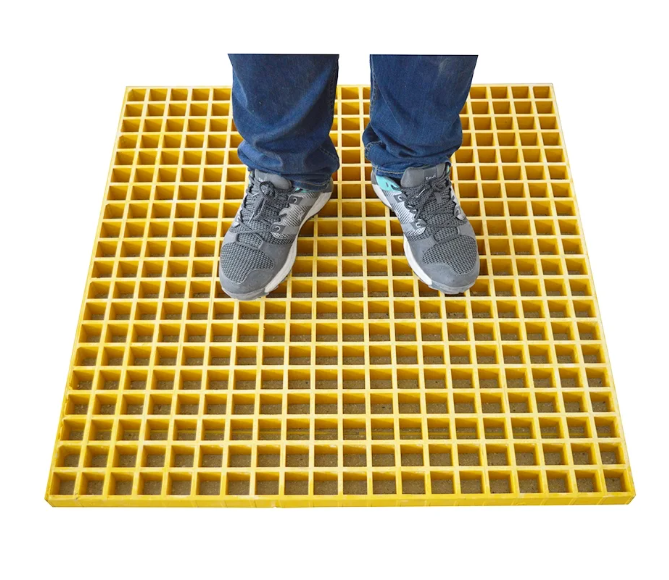
Parameter | Standard Value | Customization Range |
|---|---|---|
Length | 1200 mm | 500 - 3000 mm |
Width | 600 mm, 900 mm | 300 - 1500 mm |
Thickness | 30 mm, 38 mm, 50 mm | 25 - 60 mm |
Load Type | Performance Range | Test Condition |
|---|---|---|
Uniform Load | 3000 - 5000 N/m² | Simply supported on four sides |
Concentrated Load | 1000 - 2000 N | Single-point load at center |
Note: Actual load-bearing capacity varies based on panel thickness, span distance, and grating mesh size.
Property | Specification | Test Standard Reference |
|---|---|---|
Glass Fiber Content | ≥ 70% by weight | ASTM D2584 |
Resin Type Options | Unsaturated polyester resin, vinyl ester resin | - |
Tensile Strength | ≥ 500 MPa | ASTM D638 |
Flexural Strength | ≥ 700 MPa | ASTM D790 |
Treatment Type | Parameter | Test Condition |
|---|---|---|
Anti-slip Surface | Friction coefficient ≥ 0.6 | Dry condition, pendulum test |
Corrosion Coating | Salt spray resistance ≥ 1000 hours | ASTM B117 neutral salt spray |
Rating | Classification | Test Standard |
|---|---|---|
Flame Retardant Grade | UL94-V0 | UL 94 vertical burn test |
The corrosion resistance of fiberglass grating originates from its material composition. Unlike metallic materials that undergo electrochemical corrosion when exposed to moisture and chemicals, FRP is a non-conductive composite that does not support galvanic corrosion processes.
The resin matrix forms a continuous barrier that prevents corrosive media from reaching the glass fiber reinforcement. Unsaturated polyester resin provides resistance to a broad range of acids, alkalis, and salt solutions at ambient temperatures. Vinyl ester resin, with its higher cross-link density, offers enhanced resistance to stronger chemicals, higher temperatures, and solvent exposure, making it suitable for more aggressive industrial environments.
Additionally, the absence of iron or steel components eliminates the risk of rust formation, which commonly causes staining and structural degradation in steel grating products. This characteristic makes FRP grating particularly suitable for facilities where product contamination from rust particles must be avoided, such as food processing plants and pharmaceutical manufacturing facilities.
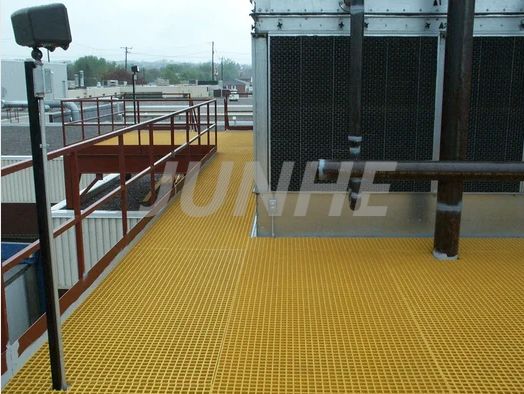
In chemical plants, fiberglass grating serves as walkway flooring, platform decking, and trench covers. The material withstands exposure to various acids, alkalis, and chemical vapors present in production areas. Common applications include acid storage areas, mixing plant platforms, and chemical dosing stations where spillage and fume exposure occur regularly. The open-grid design allows spilled liquids to drain through, reducing slip hazards and preventing chemical pooling on walking surfaces.
Wastewater treatment facilities present a combination of corrosive elements including hydrogen sulfide gas, various acids, and alkaline solutions. FRP grating is used for walkways over sedimentation tanks, aeration basins, and sludge processing areas. The material's resistance to hydrogen sulfide-induced corrosion helps maintain structural integrity in environments where steel grating may require replacement within several years of installation.
Offshore oil and gas platforms, as well as coastal industrial facilities, face constant exposure to salt spray and high humidity. Fiberglass grating withstands saltwater corrosion without requiring protective coatings or regular painting maintenance. It is used for access walkways, equipment platforms, and stair treads in these marine environments. The material's resistance to UV degradation also contributes to its performance in outdoor coastal installations.
FRP grating exhibits electrical insulation properties, making it suitable for power substations and electrical utility facilities. It is used for maintenance walkways around transformers, switchgear, and other high-voltage equipment. The non-conductive nature of the material provides an additional layer of safety for maintenance personnel working in proximity to electrical components.
Beyond heavy industrial settings, fiberglass grating finds application in commercial buildings for stair treads, rooftop walkways, and drainage grates. Its lightweight properties simplify installation and reduce structural load requirements compared to steel alternatives. The anti-slip surface contributes to pedestrian safety in areas where water or other liquids may be present on walking surfaces.
Installation of fiberglass grating typically involves cutting panels to size and securing them to supporting structures. Common cutting methods include carbide-tipped saw blades, abrasive cut-off wheels, or jigsaws with metal-cutting blades. Panels can be fastened using stainless steel clips, FRP fasteners, or adhesive bonding depending on the application requirements.
Supporting structures should be designed with appropriate span distances based on the selected grating thickness and expected load conditions. Manufacturers typically provide load-span tables that specify maximum allowable spans for different panel thicknesses under various load scenarios.
For installations requiring frequent panel removal for maintenance access, hinged grating sections or removable panel systems are available. These configurations allow personnel to lift individual sections without requiring tools for fastener removal.
Customization is available across multiple parameters to accommodate specific project requirements. Dimensional customization includes non-standard panel sizes, cutouts for equipment or pipe penetrations, and special shape configurations. Mesh size can be adjusted by modifying the spacing between load-bearing bars and cross bars, with common configurations including 30 mm × 30 mm, 38 mm × 38 mm, and 50 mm × 50 mm opening patterns.
Resin system selection is another customization dimension. Projects involving mild chemical exposure typically use isophthalic polyester resin, while applications with stronger chemical concentrations may specify vinyl ester resin formulations. Color options are available through pigmented resin systems, with yellow, gray, and green being common selections for industrial installations.
Additional customization includes integrated grit surfaces for enhanced slip resistance, solid top sections for areas where small tools or debris must not fall through, and concave or covered grating for aesthetic or safety purposes.
Production of fiberglass grating follows established quality control procedures throughout the manufacturing process. Raw material inspection includes verification of glass fiber specifications and resin batch testing. During production, parameters such as resin-to-fiber ratio, curing temperature, and molding pressure are monitored to ensure consistent material properties.
Finished products undergo testing for mechanical properties including flexural strength and impact resistance. Corrosion resistance is validated through accelerated testing methods such as salt spray exposure and chemical immersion tests. Fire performance testing verifies compliance with specified flame retardant ratings.
Service life varies based on operating conditions including chemical exposure concentration, temperature, UV exposure, and load levels. In typical industrial wastewater and chemical processing environments with moderate corrosion exposure, fiberglass grating can remain functional for 15 to 20 years or more. Actual service life depends on specific operating conditions and maintenance practices.
Fiberglass grating weighs approximately 75 percent less than equivalent steel grating of similar load capacity. For example, a 38 mm thick FRP grating panel typically weighs around 18 to 20 kg per square meter, while a comparable steel grating of similar load rating weighs approximately 70 to 80 kg per square meter. This weight difference reduces structural support requirements and simplifies handling during installation.
For general industrial applications with mild to moderate chemical exposure, unsaturated polyester resin provides adequate performance at a lower cost point. Vinyl ester resin is recommended for applications involving stronger acids, higher operating temperatures, or solvent exposure. For outdoor installations with significant UV exposure, UV-stabilized resin formulations are available. Project specifications and chemical exposure data should be reviewed with technical personnel to select the appropriate resin system.


