
- All
- Product Name
- Product Keyword
- Product Model
- Product Summary
- Product Description
- Multi Field Search
English


| Quantity: | |
|---|---|


JunHe
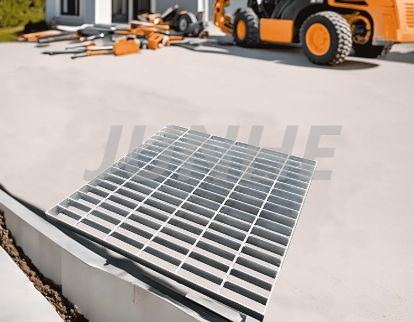
JUNHE non-slip stainless steel drainage grates are engineered for pedestrian and light-traffic pavement areas. Constructed from 304 or 316 grade stainless steel, these grates feature a serrated surface that delivers a 0.6+ friction coefficient under wet conditions. The open area ratio reaches 83.3 percent, allowing water to pass through at a rate of 1,000 liters per minute per square meter at 50mm/h rainfall intensity.
With 15 years of manufacturing experience in steel grating products, JUNHE supplies drainage solutions for municipal projects, commercial developments, and industrial facilities across 30+ countries. Each batch of grates undergoes dimensional inspection, load testing, and surface quality verification before shipment.
Component | Material Options | Grade Details |
|---|---|---|
Load-bearing flat bar | 304 Stainless Steel / 316 Stainless Steel / Q235A Carbon Steel | 304: 18-20% Cr, 8-10.5% Ni; 316: 16-18.5% Cr, 10-14% Ni, 2-3% Mo |
Cross bar | 304 Stainless Steel / Q235A Carbon Steel | Round, twisted square (5×5mm to 8×8mm), square, or hexagonal profiles |
Parameter | Specification Range | Standard Options |
|---|---|---|
Flat bar thickness | 3mm - 10mm | 3mm, 5mm, 6mm, 8mm, 10mm |
Flat bar width | 25mm - 100mm | 25mm, 30mm, 40mm, 50mm, 60mm, 100mm |
Flat bar spacing (center-to-center) | 30mm / 40mm / 60mm | 30mm, 40mm, 60mm |
Cross bar spacing (center-to-center) | 50mm / 100mm | 50mm, 100mm |
Standard panel width | 995mm | 995mm (with 5mm installation gap) |
Custom dimensions | Available upon request | Length, width, and mesh configuration |
Load Class | Capacity Rating | Typical Applications |
|---|---|---|
Light-duty | 25 tons/m² | Pedestrian walkways, park paths, bicycle lanes |
Medium-duty | 70 tons/m² | Parking lots, access roads, factory floor areas |
Heavy-duty | 140 tons/m² | Main roads, loading docks, industrial access ways |
Treatment Type | Coating Thickness | Expected Service Life |
|---|---|---|
Hot-dip galvanizing (carbon steel) | 85μm minimum | 20+ years in normal atmospheric conditions |
Electro-galvanizing (carbon steel) | 8-12μm | 5-8 years in sheltered environments |
Mechanical polishing (stainless steel) | N/A | 15+ years in outdoor exposure |
Anti-slip serrated surface | N/A | Integral to flat bar profile |
Performance Indicator | Measured Value | Test Condition |
|---|---|---|
Open area ratio | Up to 83.3% | 30mm flat bar spacing configuration |
Water discharge rate | 1,000 L/min per m² | 50mm/h rainfall intensity |
Hydraulic efficiency | 0.75 discharge coefficient | Standard grate inlet test method |
The anti-slip feature is achieved through serrated flat bars, where the top surface of each bearing bar is pressed with diagonal teeth. This design increases surface roughness without compromising structural integrity. Laboratory testing records a friction coefficient of 0.6 or higher when the surface is wet, measured according to ASTM F1677 test method using the British Pendulum Tester.
Surface Condition | Friction Coefficient (BPN) |
|---|---|
Dry, clean surface | 75-85 |
Wet with water | 60-70 |
Contaminated with oil film | 45-55 |
Note: Values are typical test results. Actual performance may vary based on installation angle, wear condition, and contaminant type.
304 grade stainless steel contains 18 to 20 percent chromium and 8 to 10.5 percent nickel. This austenitic alloy provides resistance to atmospheric corrosion, fresh water, and many mild chemical environments. It is suitable for urban pavements, commercial building perimeters, and parking structures where de-icing salts may be present occasionally.
316 grade stainless steel adds 2 to 3 percent molybdenum to the alloy composition, enhancing resistance to chloride-induced corrosion. This material is recommended for coastal installations, wastewater treatment facilities, and areas exposed to salt spray or chemical runoff. The pitting resistance equivalent number (PREN) for 316 stainless steel is approximately 24-26.
For projects with budget constraints, Q235A carbon steel grates with hot-dip galvanizing are available. The zinc coating, applied at 85μm minimum thickness per ASTM A123 standard, forms a metallurgical bond with the steel substrate. This treatment provides cathodic protection and barrier protection against corrosion.
Installed in curb gutters and pedestrian crossings, stainless steel drainage grates manage stormwater runoff while maintaining pedestrian safety. The serrated surface reduces slip risk during rainy weather, and the stainless steel material withstands de-icing salts used in winter maintenance.
Shopping centers, office buildings, and hotel entrances require drainage solutions that combine function with appearance. Stainless steel grates offer a clean, consistent look that complements modern architecture while handling foot traffic volumes of 10,000+ people per day.
Factory perimeters, warehouse loading areas, and industrial park roads generate both vehicle traffic and occasional chemical spills. The appropriate load class grating selected based on traffic weight, combined with corrosion-resistant material selection, addresses both drainage and safety requirements for industrial applications.
Public parks, sports facilities, and pedestrian promenades experience high foot traffic and periodic flooding events. Non-slip drainage grates installed along pathways and around fountain areas prevent standing water accumulation. The smooth edges and flush installation eliminate trip hazards for visitors of all ages.
Multi-story parking garages and underground parking structures require systematic drainage to remove water tracked in by vehicles. Stainless steel trench grates installed across ramps and along perimeter channels direct water to drainage systems while providing traction for both vehicles and pedestrians.
304 stainless steel contains 18-20% chromium and 8-10.5% nickel, providing resistance to atmospheric corrosion and fresh water exposure. 316 stainless steel adds 2-3% molybdenum, which significantly improves resistance to chloride corrosion. For inland pavement installations with normal rainfall exposure, 304 grade is typically sufficient. For coastal areas, wastewater applications, or environments with de-icing salt exposure, 316 grade is recommended.
Load class selection depends on the heaviest vehicle type that will traverse the grate. Light-duty grates (25 tons/m²) serve pedestrian areas and bicycle paths. Medium-duty grates (70 tons/m²) handle passenger cars and light trucks up to 20 tons gross vehicle weight. Heavy-duty grates (140 tons/m²) accommodate heavy trucks and industrial equipment. For projects with specific traffic data, engineers can calculate equivalent single-wheel loads to verify the appropriate rating.
Service life varies based on material grade and environmental conditions. 304 stainless steel grates typically last 15-25 years in normal urban pavement environments. 316 stainless steel grates may last 20-30 years in coastal or moderately corrosive settings. Actual service life depends on factors including maintenance frequency, chemical exposure, abrasion from traffic, and installation quality.
Yes, stainless steel drainage grates can be retrofitted into existing concrete or polymer concrete channels. The installation process involves measuring the existing channel dimensions, selecting or fabricating grates with matching frame dimensions, and securing them in place. For channels with irregular dimensions, custom-sized grates can be manufactured to ensure proper fit and load distribution.
Regular maintenance involves removing accumulated debris, leaves, and sediment from the grate surface and channel interior. For routine cleaning, a broom or pressure washer at 1,500-2,500 psi is sufficient. Stainless steel surfaces may develop tea staining in high-chloride environments, which can be removed with a non-abrasive stainless steel cleaner. Annual inspection of frame integrity and grate seating is recommended.
For standard-sized stainless steel grates, the minimum order quantity starts at 10 square meters. For custom dimensions or special configurations, minimum quantities may vary based on production setup requirements. Sample panels for evaluation and testing can be provided at smaller quantities, with lead times of 7-10 working days.
Standard-sized stainless steel drainage grates in 304 grade typically ship within 15-20 working days from order confirmation. Custom-sized orders or 316 stainless steel material may require 20-30 working days. Large-volume orders (500+ square meters) are scheduled based on production capacity, with specific delivery timelines confirmed at the time of quotation.


