
- All
- Product Name
- Product Keyword
- Product Model
- Product Summary
- Product Description
- Multi Field Search
English


| Quantity: | |
|---|---|


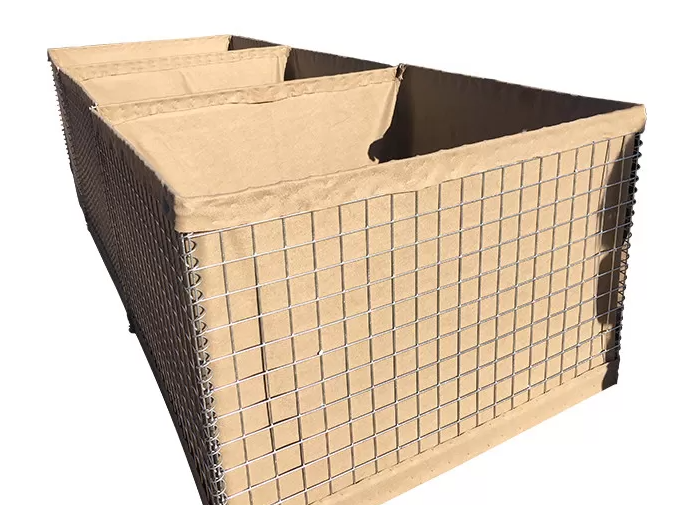
The JUNHE modular galvanized defense barrier is a prefabricated wire mesh containment system designed for flood control, perimeter security, and erosion control applications. Each unit consists of welded wire mesh panels joined with helical coils, forming a three-dimensional cellular structure that can be filled with locally sourced sand, gravel, or soil on site.
Manufactured with low-carbon steel wire and hot-dip galvanized coating, these barriers arrive at the job site in collapsed, flat-pack form for efficient transportation. Once deployed and filled, the units interlock to create continuous, self-supporting walls that conform to uneven terrain. The system requires no heavy foundation work and can be disassembled and relocated for use at multiple sites.
Commercial users in municipal engineering, military facilities, and industrial site protection commonly deploy these barriers for temporary or semi-permanent installations. The modular nature allows configurations ranging from single-layer flood walls to multi-tiered defensive structures, depending on project requirements.
Parameter | Specification |
|---|---|
Wire diameter | 4 mm - 5 mm |
Mesh opening | 76.2 mm × 76.2 mm (3" × 3") |
Standard unit length | 1 m / 2 m / 3 m |
Standard unit height | 0.61 m / 1 m / 1.37 m / 1.52 m / 2 m / 2.21 m |
Standard unit width | 0.61 m / 1 m / 1.37 m |
Wire material | Low-carbon steel wire (Q195 / Q235) |
Surface treatment | Hot-dip galvanized (zinc coating: 230 g/m² - 280 g/m²) |
Alternative coating | Zinc-aluminum alloy (Galfan, 5% Al - 95% Zn) |
Geotextile lining | Polypropylene non-woven, 200 g/m² - 300 g/m² |
Connection method | Helical coil springs, 3.0 mm diameter |
Tensile strength of wire | 350 N/mm² - 550 N/mm² |
Salt spray resistance | ≥ 1000 hours (hot-dip galvanized) |
 |  |
Performance Indicator | Test Result | Test Condition |
|---|---|---|
Static load capacity | 12 kN/m² | Uniformly distributed load on top surface |
Hydrostatic pressure resistance | 1.5 m water head | Single-layer barrier filled with sand |
Impact resistance | Withstands 120 mm mortar shrapnel at 10 m distance | Military standard test |
Wind load resistance | 120 km/h | Empty unit, anchored to ground |
Seismic performance | Grade 8 intensity | Filled unit, horizontal acceleration test |
The installation process follows four sequential steps: site preparation, unit unfolding, connection, and filling.
First, the deployment area requires clearing of sharp debris that could puncture the geotextile lining. A level base is preferred but not mandatory, as the flexible wire mesh structure accommodates ground unevenness of up to 100 mm per linear meter.
Second, collapsed units are manually lifted into position and unfolded to their full dimensions. Each unit weighs approximately 15 kg - 35 kg depending on size, allowing two workers to handle standard units without mechanical assistance.
Third, adjacent units are joined using helical coil springs that thread through the mesh openings. A standard 100-meter barrier requires approximately 150 - 200 connection springs, supplied with each shipment.
Fourth, filling proceeds using excavators or front-end loaders for sand, gravel, or locally available soil. The geotextile lining retains fill material while allowing water drainage, preventing hydrostatic buildup behind the barrier.
Configuration | Crew Size | Daily Output (8-hour shift) |
|---|---|---|
Single-layer (1 m height) | 5 workers + 1 excavator | 80 m - 120 m |
Double-layer (2 m height) | 7 workers + 1 excavator | 40 m - 60 m |
Emergency deployment (sandbag comparison) | Same crew size | 6 - 8 times faster than sandbag method |
For flood protection applications, the galvanized defense barrier forms temporary or semi-permanent levees along rivers, lakes, or coastal areas. When filled with sand or gravel, a 1-meter high barrier can contain water depths of 0.8 m - 0.9 m under static conditions. Municipal authorities and water conservancy departments use these systems for emergency flood response, seasonal flood preparation, and construction site dewatering.
The geotextile lining allows gradual water seepage while preventing soil erosion, maintaining structural integrity during extended flood events. Typical deployment scenarios include urban flood control, industrial plant protection, and infrastructure safeguarding during typhoon seasons.
Industrial facilities, logistics parks, and temporary event venues use modular barriers as perimeter security elements. Filled with concrete or compacted soil, the barriers serve as vehicle access control points and anti-ram barriers. The wire mesh structure can be combined with barbed wire or electric fencing for enhanced security levels.
Construction sites commonly deploy these barriers to define work zones, protect public safety, and prevent unauthorized access. The modular design allows reconfiguration as project phases progress, reducing the need for permanent fencing installations.
In civil engineering projects, galvanized wire mesh barriers function as retaining walls for slope stabilization and riverbank protection. When filled with rock or gravel, the cellular structure dissipates water flow energy, reducing scouring along channels and embankments. Highway departments use these systems for roadside slope protection and drainage channel lining.
For coastal erosion control, the barriers can be stacked in stepped configurations to absorb wave energy. The zinc coating provides corrosion resistance in saltwater environments, with an expected service life of 10 - 15 years in moderate coastal exposure conditions.
Military engineering units deploy these barriers for force protection applications, including perimeter defense, bunker reinforcement, and ammunition depot protection. The system's rapid deployment capability makes it suitable for forward operating bases and temporary security positions.
The welded wire mesh construction provides fragmentation resistance, while the fill material absorbs blast energy. Standard 1.37 m high units filled with sand offer protection against 120 mm mortar fragments at standoff distances of 10 meters or more, according to military ballistic testing standards.
All steel wire components undergo hot-dip galvanizing per ASTM A641 / ISO 7989 standards. The zinc coating mass ranges from 230 g/m² to 280 g/m², corresponding to an average coating thickness of 32 μm - 39 μm. This coating level provides corrosion protection suitable for outdoor exposure in temperate climates.
For projects in coastal areas or industrial environments with elevated corrosion risk, zinc-aluminum alloy coating (Galfan) is available as an upgrade option. The 5% aluminum - 95% zinc composition offers approximately 2 - 3 times the corrosion resistance of standard galvanizing in salt spray testing.
Environment | Hot-Dip Galvanized | Zinc-Aluminum Alloy |
|---|---|---|
Rural / inland | 15 - 20 years | 25 - 30 years |
Urban / industrial | 10 - 15 years | 20 - 25 years |
Coastal (moderate) | 8 - 12 years | 15 - 20 years |
Coastal (severe) | 5 - 8 years | 10 - 15 years |
Service life estimates assume normal atmospheric exposure and no physical damage to the coating. Fill material pH levels between 6.0 and 8.0 do not significantly accelerate corrosion of buried wire components.
The flat-pack design allows 5 - 7 times more units per shipping container compared to pre-assembled barriers. A standard 40-foot HC container holds approximately 300 - 400 linear meters of 1-meter high barriers, depending on unit specifications. This reduces per-unit shipping costs by 60% - 70% compared to fully assembled alternatives.
Each pallet typically contains 20 - 30 collapsed units, secured with steel strapping for ocean freight. The compact dimensions also simplify storage at job sites and in warehouse facilities.
Using locally sourced fill material represents a significant cost advantage over pre-cast concrete or sandbag systems. Sand, gravel, or on-site excavated soil can all serve as fill, eliminating the need to import specialized materials. For remote project locations, this can reduce material transportation costs by 80% or more.
The fill material remains usable after barrier removal, allowing redistribution for other site works. This circular approach reduces construction waste and associated disposal costs.
The steel wire mesh structure maintains structural integrity through multiple deployment cycles. With proper handling and storage, barriers can be disassembled, transported, and reinstalled 5 - 10 times before requiring replacement of worn components.
Helical coils and geotextile liners are available as replacement parts, extending the service life of the main wire mesh frames. This modular repairability reduces total lifecycle cost compared to single-use flood control products.
The minimum order quantity starts from 50 linear meters for standard specifications. Custom dimensions and special coatings may require higher minimum quantities, typically starting from 200 linear meters. Sample units are available for evaluation purposes at standard unit pricing plus shipping costs.
Standard specifications are typically available from stock or within 7 - 10 working days of order confirmation. Custom production runs require 15 - 25 working days depending on order volume and specifications. Ocean freight from Chinese ports to major global destinations takes 25 - 40 days depending on the destination port.
Yes, the modular design accommodates slopes with gradients up to 15 degrees. For steeper terrain, stepped installation is recommended, with each unit leveled individually using fill material beneath the base. The flexible wire mesh construction conforms to minor ground undulations without structural compromise.
Common fill materials include clean sand, gravel (5 mm - 50 mm diameter), crushed stone, and well-graded soil. Fill material should be free of sharp objects larger than 20 mm that could puncture the geotextile lining. For flood control applications, sand or sandy loam with less than 10% silt content provides optimal performance.
The polypropylene geotextile lining is sewn into the wire mesh frame during manufacturing and secured with cable ties at all edges. Replacement liners are available for units that have sustained lining damage. Replacement requires removing the old liner and securing the new liner with stainless steel cable ties at 200 mm intervals along all mesh edges.
Yes, all standard products come with factory test reports covering wire tensile strength, zinc coating mass, and mesh dimensional accuracy. Third-party inspection reports from SGS, BV, or TUV can be arranged at buyer's request, typically requiring 3 - 5 working days for sample testing and report issuance.


