
- All
- Product Name
- Product Keyword
- Product Model
- Product Summary
- Product Description
- Multi Field Search
English


| Quantity: | |
|---|---|


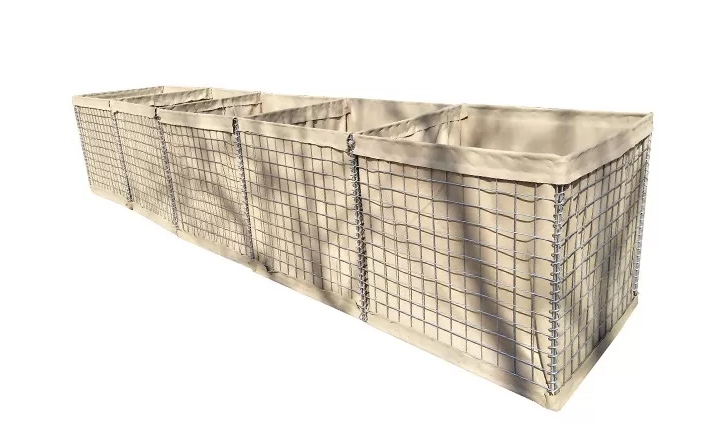
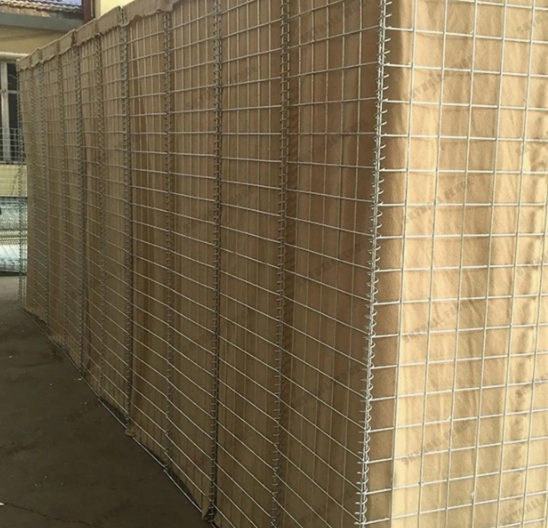
JUNHE blast-resistant galvanized military defense barriers are modular protective systems designed for security and defense applications. Each unit combines welded steel wire mesh frames with non-woven geotextile lining, creating containers that can be filled with locally sourced sand, gravel, or soil. The hot-dip galvanized coating provides corrosion resistance for outdoor deployment, while the quick-connect spring system allows for assembly without specialized tools.
These barriers support rapid field deployment for perimeter security, blast mitigation, and ballistic protection. The modular design enables configuration into walls, bunkers, watchtowers, and compound perimeters based on specific operational requirements.
Parameter | Value |
|---|---|
Wire diameter | 4 mm - 5 mm |
Wire material | Hot-dip galvanized steel wire / Zinc-aluminum alloy wire |
Mesh opening | 76.2 mm × 76.2 mm (3" × 3") |
Galvanized coating thickness | ≥ 220 g/m² |
Geotextile fabric weight | 250 g/m² - 300 g/m² |
Geotextile material | Polypropylene (PP) non-woven |
Connection type | Spring wire / spiral fasteners |
 |  |
Model | Length (m) | Width (m) | Height (m) |
|---|---|---|---|
MIL-1 | 1.06 | 0.61 | 0.61 |
MIL-2 | 1.37 | 1.06 | 1.06 |
MIL-3 | 2.21 | 1.52 | 1.52 |
MIL-4 | 3.05 | 1.52 | 2.07 |
MIL-5 | 3.66 | 1.52 | 2.21 |
Custom dimensions available upon request for commercial procurement projects.
The barrier frame uses resistance-welded steel wire mesh panels joined at each intersection point. The 4 mm - 5 mm wire diameter provides structural rigidity when filled, while the 76.2 mm × 76.2 mm mesh opening balances material weight with containment performance. All steel components undergo hot-dip galvanizing after welding, ensuring complete coating coverage at weld joints.
Each unit includes a sewn polypropylene geotextile liner attached to the interior of the wire mesh frame. The liner retains fill material while allowing water drainage, preventing hydrostatic pressure buildup. The 250 g/m² - 300 g/m² fabric weight provides puncture resistance during filling operations. The geotextile is available in tan, olive green, or sand colors to match operational environments.
Defense barriers serve as perimeter walls around military installations, forward operating bases, and command centers. When filled with compacted sand or gravel, the units create mass walls that provide ballistic protection against small arms fire and shrapnel from 120 mm mortar rounds. Multiple layers can be stacked to increase protection levels for high-priority facilities such as ammunition depots and command posts.
For shooting ranges and training facilities, these barriers function as backstops and side containment walls. The filled units absorb bullet energy and prevent ricochets, while the modular design allows configuration to fit various range layouts. Barriers can be rearranged as training requirements change, supporting dynamic shooting exercises and tactical training scenarios.
Beyond security applications, galvanized defense barriers deploy as temporary flood walls in emergency situations. Units filled with locally available sand or aggregate create continuous water-retaining barriers along riverbanks, coastal areas, or urban flood zones. The rapid assembly capability allows emergency response teams to establish flood protection within hours, reducing property damage during flood events.
The deployment process follows three primary steps. First, unfold the collapsed barrier units at the deployment location and position them along the desired alignment. Second, connect adjacent units using the provided spring wire fasteners, ensuring proper alignment at vertical joints. Third, fill the units with sand, gravel, or soil using excavators or front-end loaders, compacting fill material in layers for uniform density.
A standard crew of five personnel can assemble approximately 50 linear meters of barrier wall in 1.5 hours, including filling operations. The system requires no heavy construction equipment for assembly, only material handling machinery for filling.
When properly filled with compacted sand, the barriers provide shrapnel protection from 120 mm mortar rounds and ballistic protection against common small arms calibers. Protection levels vary based on barrier thickness, fill material type, and compaction density. Project-specific performance data is available upon request for industrial applications.
Yes, customization options include unit dimensions, wire diameter, mesh opening size, galvanized coating weight, geotextile fabric weight and color, and connection hardware type. Custom printing or branding on geotextile is also available for enterprise customers. Minimum order quantities apply to custom configurations.
Service life depends on environmental conditions and maintenance practices. Hot-dip galvanized steel components typically provide 10 - 15 years of corrosion resistance in temperate outdoor environments. Zinc-aluminum alloy coatings offer extended service life in coastal or high-humidity areas. Geotextile liners are UV-stabilized for 5 - 8 years of exposed outdoor use and can be replaced if damaged.
Units ship in collapsed, flat-packed bundles to maximize container utilization. Standard packaging includes bundled wire mesh frames and separately rolled geotextile liners, with connection hardware included in each bundle. A 20-foot container holds approximately 200 - 300 units depending on model size. Full container load (FCL) and less than container load (LCL) shipping options are available for business operations.
Standard models are available from stock with lead times of 7 - 15 days for quantity orders. Custom specifications require 20 - 30 days of production time depending on order volume. Sample units are available for evaluation purposes before placing bulk orders.
For commercial procurement inquiries, technical specifications, or custom project quotations, contact our sales team with your requirements including model selection, quantity, delivery location, and any customization needs. Our technical support team provides project planning assistance and deployment guidance for large-scale installations.


