
- All
- Product Name
- Product Keyword
- Product Model
- Product Summary
- Product Description
- Multi Field Search
English


Views: 0 Author: Site Editor Publish Time: 2026-09-28 Origin: Site


Specifying structural materials demands absolute precision in industrial environments. Choosing the wrong panel thickness poses immediate safety risks. You risk catastrophic structural failure under heavy loads. Conversely, over-engineering wastes your project budget and complicates on-site installation. Many engineering teams focus heavily on material chemistry alone. They prioritize corrosion resistance and non-conductivity during procurement. However, they often overlook crucial mechanical thresholds dictated by panel depth. Getting this dimension right ensures structural integrity immediately. It prevents hazardous deflections and guarantees safe daily operations. You need hard engineering parameters to make an informed choice. We will break down the precise structural capabilities of 30mm, 38mm, and 50mm panels. This guide provides actionable insights for your next build. You will learn how to finalize specifications based on span distances, load types, and strict compliance limits.
30mm FRP Grating: Ideal for standard pedestrian walkways with continuous support or short spans; highly cost-effective and lightweight.
38mm FRP Grating: The industry standard. Balances strength and cost for general industrial platforms, trench covers, and light-cart traffic.
50mm FRP Grating: Built for extreme environments, heavy vehicular/forklift traffic, or applications requiring extended spans with minimal substructure supports.
The Golden Rule: Thickness dictates mechanical strength and max span capability, while resin type dictates chemical and fire resistance.
Every structural platform relies on predictable mechanical behavior. Panel depth serves as the primary driver for bending strength. We must evaluate how thickness interacts directly under physical stress. You cannot guess these parameters safely. Engineers look at several distinct forces to determine viability.
We evaluate uniform versus concentrated loads first. A uniform load spreads weight evenly across the entire surface. Think of snow accumulation or heavy fluid tanks resting flat. Concentrated loads apply intense pressure to a single pinpoint. A heavy machine leg creates massive localized stress. A thicker panel distributes this pinpoint energy much more effectively. We categorize these profiles into specific daily occurrences:
Static Uniform Loads: Stationary equipment, storage tanks, and natural snow loads.
Dynamic Uniform Loads: Groups of workers walking across a wide platform simultaneously.
Static Concentrated Loads: Fixed machinery legs resting on a specific grid node.
Dynamic Concentrated Loads: Rolling heavy toolboxes or sudden drops of heavy equipment.
Consider span distances and your support substructures carefully. Span distance refers to the open gap between structural beams. Panel depth correlates directly to allowable unsupported distances. You must bridge these gaps safely without dangerous bowing. Deeper grids contain more fiberglass rovings. They handle tensile stress better over long distances.
Standard safety regulations define strict deflection thresholds for walkways. A common industry limit restricts bending to 6mm under maximum load. Exceeding this 1/4-inch limit compromises structural integrity instantly. It also creates a distinct psychological hazard for facility workers. Walking on a bouncing surface feels inherently unsafe. Thicker panels inherently resist bending over longer structural gaps.
Finally, you must calculate dead load versus live load. Dead load represents the physical weight of the panel itself. Thicker dimensions add substantial permanent weight to your platform structure. Live load encompasses moving personnel, rolling carts, and temporary equipment. Your substructure must support both forces simultaneously without buckling.
Table 1: Standard Load and Span Capabilities by Thickness
Grating Thickness | Max Pedestrian Span (Safe) | Max Vehicular Span | Relative Panel Weight |
|---|---|---|---|
30mm | 600mm - 750mm | Not Recommended | Lightweight (Easy Manual Lift) |
38mm | 900mm - 1000mm | Light Carts Only | Medium (Manageable by 2 Workers) |
50mm | 1200mm+ | Forklifts / HGV Compatible | Heavy (Requires Mechanical Lift) |
Selecting 30mm FRP grating provides an excellent baseline for pedestrian access. We primarily use this dimension for standard walkways and elevated catwalks. It serves exceptionally well in platforms seeing strictly light foot traffic.
You must respect its strict span limitations to ensure absolute safety. Safe working spans usually max out around 600mm to 750mm. Bridging gaps up to 30 inches maintains standard deflection limits perfectly. Pushing spans wider invites unsafe bouncing and potential material failure. Continuous structural support guarantees the longest lifespan for these panels.
This dimension offers compelling financial and operational advantages for builders. It carries the lowest material cost per square meter. It also represents the lightest option available in standard inventory catalogs. These traits simplify logistics considerably during facility upgrades. You require minimal mechanical lifting equipment during site installation. Consider these operational benefits:
Two workers can easily carry and position these lightweight panels manually.
Contractors navigate tight stairwells and confined spaces effortlessly.
On-site cutting proceeds rapidly using standard diamond-grit circular saws.
Faster installation timelines drive down overall project labor expenses significantly.
However, you must understand the severe risks of misapplication. This depth cannot survive brutal industrial environments safely. It remains highly unsuitable for areas experiencing heavy rolling carts. Pallet jacks will destroy the surface grid rapidly under direct pressure. Heavy tool drops can crack the lighter mesh easily. You face a high risk of localized failure under dynamic loads.
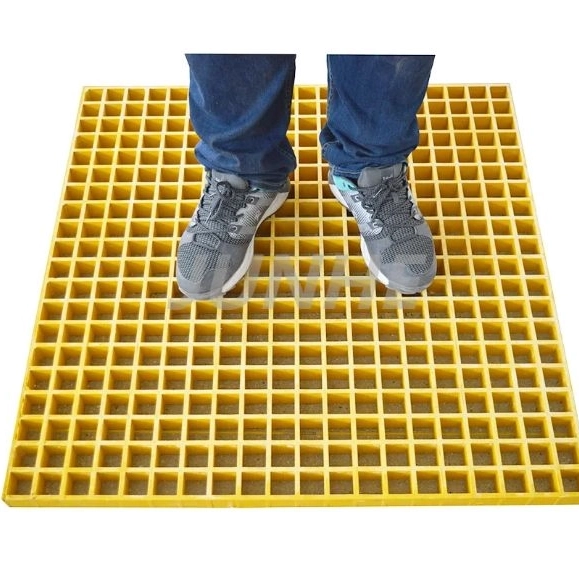
Most structural engineers consider 38mm FRP grating the definitive industry standard today. We see this exact dimension specified across countless global projects. It dominates general manufacturing facilities and massive offshore drilling platforms. Chemical plants and municipal water treatment facilities rely heavily on it.
Engineers affectionately call this size the dependable workhorse balance. It measures exactly 1.5 inches deep in imperial markets. This dimension acts as the perfect default specification for unsure teams. It offers a crucial safety buffer for unpredictable load spikes. You gain robust strength without suffering extreme weight penalties.
This versatile option bridges spans safely between 900mm and 1000mm. Crossing 40-inch gaps safely makes it incredibly useful for general layouts. It supports standard industrial foot traffic effortlessly day after day. It also handles light wheeled equipment without dangerous sagging. Janitorial carts and small maintenance trolleys traverse it smoothly.
Field crews handle these panels easily during primary installation phases. You do not need specialized cranes for standard positioning tasks. However, dynamic industrial loads require secure fastening methods always. You must install robust clipping systems to prevent panel shifting. Standard M-clips or C-clips lock the panels tightly to support beams. Proper fastening prevents dangerous grid movement under heavy vibration. We highly recommend utilizing 316 stainless steel hardware to prevent localized corrosion.
Extreme industrial environments demand unparalleled structural resilience from flooring materials. We deploy 50mm FRP grating exclusively for punishing applications. Primary uses include busy loading docks and heavy trench covers. Forklift traffic zones absolutely require this massive panel depth. Facilities accommodating Heavy Goods Vehicle loading rely entirely on this specification.
Its span capabilities outpace lighter options dramatically in structural testing. This robust material easily clears wide spans exceeding 1200mm. Bridging gaps larger than 48 inches maintains strict structural integrity. This capability drastically reduces your need for secondary steel supports.
Impact resistance sets this extreme thickness apart from standard panels. It absorbs severe shock from dropped heavy equipment effortlessly. Dynamic vehicular braking forces will not tear the dense grid apart. Solid rubber forklift wheels generate immense horizontal shear force during stops. The deep resin and glass matrix dissipates this kinetic energy safely. It survives brutal environments where traditional steel grids bend permanently.
You must accept certain implementation trade-offs carefully before purchasing. This premium material carries a substantially higher upfront purchase price. Heavy panel weights eliminate manual handling options entirely on site. You must utilize mechanical lifting aids like cranes or forklifts. Proper installation requires precise rigging and experienced heavy-duty contractors. Slower fabrication speeds also increase your total project timeline slightly.
Engineers follow a strict methodology to finalize material dimensions. You should use this structured approach to validate your choices. This framework ensures safe operations while optimizing project budgets. Integrating resilient FRP grating correctly requires methodical planning.
Map out your existing or planned structural support beams meticulously. Measure the exact open distance between structural steel flanges carefully. If unsupported spans exceed 1000mm, standard depths fail safety requirements. We typically disqualify 30mm and 38mm options immediately here. You must step up to a thicker profile instantly.
Never base your specifications on average daily use only. You must spec for the absolute heaviest potential localized load. Consider rare events like a massive maintenance motor replacement. Account for sudden emergency vehicle access on pedestrian zones. Calculate the pinpoint stress of a heavy tool drop. A platform rated only for pedestrians fails catastrophically if a 2-ton motor rests on it.
Thick panels cost more per square meter initially. However, spending more on heavier panels alters substructure engineering completely. It allows you to build fewer steel support beams beneath. Reducing structural steel purchases often lowers the overall project cost. You save significantly on heavy metal fabrication and welding labor. Sometimes, buying the most expensive grating yields the cheapest total installation budget.
Assess your exact installation environment carefully before purchasing materials. Confined spaces restrict lifting equipment severely during retrofits. Retrofitting old platforms often occurs without any crane access. Strict safety protocols regarding manual lifting limits might mandate lighter panels. You may need 30mm sections simply to comply legally with local labor protection laws.
Chart 1: Environmental Application Matrix
Application Scenario | Optimal Thickness | Primary Engineering Driver |
|---|---|---|
Rooftop HVAC Maintenance Walkway | 30mm | Lightweight handling, low cost, pedestrian-only traffic. |
Chemical Plant Vat Surround | 38mm | Standard foot traffic, occasional dropped tools, 36-inch spans. |
Offshore Oil Rig Stair Treads | 38mm | Ideal balance of weight vs. high-impact foot traffic. |
Loading Dock Drainage Trench | 50mm | Forklift rolling loads, dynamic braking forces, wide gaps. |
Selecting between 30mm, 38mm, and 50mm depths remains critical. It is an exercise in balancing load requirements safely. You must align support spans and project budgets perfectly. Thicker panels deliver unmatched strength for extreme vehicular demands. Lighter panels optimize installation costs for simple pedestrian access walkways.
Advise your engineers to cross-reference exact load data thoroughly. Check manufacturer-specific Load and Deflection Tables before issuing purchase orders. Always demand material test reports (MTRs) from your supplier directly. These documents verify load claims and ensure absolute compliance. Make data-driven decisions to protect your facility structure and personnel.
A: Only if the trench is extremely narrow, typically under 600mm. It must remain restricted solely to light pedestrian traffic. If carts, pallet jacks, or vehicles cross the trench, you risk immediate structural failure. In those dynamic scenarios, upgrading to 38mm or 50mm is absolutely required.
A: No. Thickness provides mechanical strength and structural rigidity only. Chemical resistance is dictated entirely by the resin system used during manufacturing. You must select the correct resin formulation—such as Orthophthalic, Isophthalic, or Vinyl Ester—to survive specific corrosive environments effectively.
A: Yes, but it requires careful substructure engineering and planning. Support ledges must be staggered in height specifically. This ensures the top walking surface remains perfectly flush across transitions. Uneven surfaces create severe trip hazards for facility personnel and catch rolling equipment wheels.
A: Cutting 50mm grating requires heavier-duty diamond-grit blades. You must use significantly slower feed rates during fabrication. Rushing the cut causes severe resin burning and edge fraying. This careful approach inherently increases fabrication time and labor costs compared to processing lighter 30mm panels.


