
- All
- Product Name
- Product Keyword
- Product Model
- Product Summary
- Product Description
- Multi Field Search
English


Views: 0 Author: Site Editor Publish Time: 2026-06-18 Origin: Site


Industrial flooring demands a precise balance to function correctly. Facilities need constant structural integrity, high personnel safety, and long-term budget predictability. Material failure in harsh operational environments creates severe consequences. It leads to incredibly expensive operational downtime. It also introduces critical safety liabilities for facility owners and operators.
We introduce Galvanized Steel Grating as the primary solution to these challenges. This versatile material serves as the industry-standard workhorse for demanding heavy-duty applications. It solves complex load requirements and corrosion challenges reliably across multiple sectors.
This article provides procurement managers and structural engineers a clear evaluation framework. We cover exact load specifications and environmental suitability standards. You will also learn about critical implementation risks. We outline these key factors to ensure correct material selection for your next major infrastructure project.
Hot-dip galvanizing provides a triple-layer protection mechanism (physical barrier, cathodic protection, and zinc patina), enabling a 50+ year lifespan in standard atmospheric conditions.
Selection depends on exact load profiles, with bearing bar pitches ranging from 30mm (heavy industrial) to 60mm (mining/debris clearance).
For non-caustic environments, galvanized carbon steel offers superior stiffness (Modulus of Elasticity) at a substantially lower Total Cost of Ownership (TCO) compared to stainless steel.
*Critical Trap:* Field-cutting pre-galvanized grating destroys the protective layer; custom panels must be fabricated prior to hot-dip galvanizing.
Hot-dip galvanizing defends raw carbon steel against severe elemental exposure. This process relies on robust scientific principles rather than simple surface coverage. We see it prevent structural fatigue through a proven triple-layer protection mechanism.
Physical Barrier: The process creates a strong metallurgical bond. Zinc alloys directly into the steel surface at temperatures exceeding 800 degrees Fahrenheit. This bond resists physical impacts far better than standard epoxy coatings. It prevents chipping during heavy equipment traffic.
Cathodic Protection (Sacrificial Anode): Zinc acts as a sacrificial anode. It sacrifices itself to protect the underlying carbon steel. If heavy machinery scratches the surface, the surrounding zinc diverts corrosion away from the exposed metal.
Zinc Patina: The coating develops a natural secondary passivation layer. It reacts chemically to oxygen and moisture over time. This patina forms an insoluble shield. It significantly slows the overall degradation rate of the panel.
This unique chemistry dictates the maintenance and lifecycle reality of the flooring. The open-area design prevents standing water. It actively stops debris accumulation. The combination of high open areas and hot-dip galvanizing virtually eliminates routine maintenance. You can expect a reliable 50-year lifespan in standard commercial environments. Regular outdoor installations rarely require touch-ups or expensive replacements during their operational life.
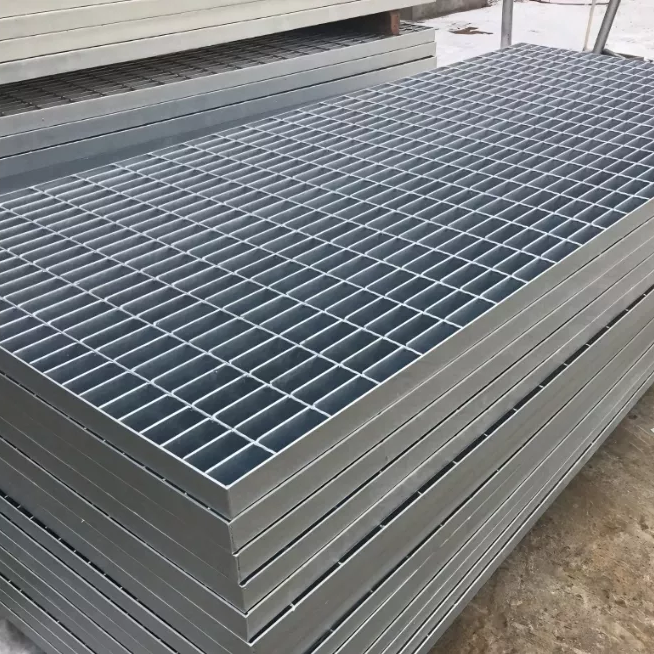
Engineers evaluate bearing bars and spacing matrices before approving any structural design. You must align the cross-sectional profile to your precise load requirements. We break down the primary configurations below.
Industry professionals rely on two main bearing bar shapes for industrial flooring.
Flat Bar: This universal profile offers exceptional versatility. It simplifies installation across standard platforms. You will find it heavily utilized in typical commercial walkways, stair treads, and standard industrial plants.
I-Bar: This profile provides an optimized strength-to-weight ratio. The I-shape minimizes the overall weight of the panel. It still maintains massive load capacities. We recommend it for extreme load scenarios. It helps minimize supporting steel requirements below the flooring structure.
Pitch refers to the precise center-to-center spacing between bearing bars. Proper pitch selection prevents catastrophic failures and ensures operational safety.
Pitch Size | Classification | Ideal Application Scenarios |
|---|---|---|
30mm Pitch | Heavy Industrial Standard | Maximizes lateral impact resistance. Perfect for heavy rolling loads and high-traffic pedestrian areas. |
40mm Pitch | Economic Light-Duty | Best for fixed walkways, catwalks, and shelving. Suitable where continuous heavy loading is absent. |
60mm Pitch | Mining & Specialized | Allows heavy debris and mineral spillage to fall through. Mitigates accumulation risks in processing plants. |
Material dimensions dictate maximum span capabilities in the field. Heavy-duty Steel Grating variations easily support over 400 psf (pounds per square foot). These advanced configurations can span up to 1.5 meters entirely unsupported. Your exact span limit depends heavily on bar thickness and depth. Always consult specific manufacturer load tables before finalizing unsupported spans for commercial projects.
Many procurement teams struggle when comparing galvanized carbon steel against stainless alternatives. Both materials offer distinct mechanical advantages. We must compare them objectively based on material mechanics and specific capability thresholds.
You must understand two critical engineering metrics: Modulus of Elasticity and Yield Strength.
Modulus of Elasticity: This measures overall stiffness. It defines how well a material resists bending under heavy pressure. Galvanized carbon steel excels here. It delivers a rigid, unyielding surface under heavy forklift traffic.
Yield Strength: This measures resistance to permanent deformation. Stainless steel often leads in this category. It withstands massive permanent destruction thresholds but flexes significantly more under regular loads.
Metric | Galvanized Carbon Steel | Stainless Steel (Type 304/316) |
|---|---|---|
Stiffness (Modulus) | Superior rigidity. Exhibits minimal bounce under load. | High strength but noticeably more flexible. |
Chemical Resistance | High (Ideal for Atmospheric/Salt Spray) | Maximum (Ideal for Caustic/Acids) |
Initial Financial Outlay | Highly Economical | Premium Capital Expenditure |
You must balance your initial financial capabilities against environmental realities.
When to choose Galvanized: It provides the most efficient financial allocation for 90% of outdoor projects. This includes HVAC infrastructure, heavy transportation docks, and coastal oil facilities facing salt-spray. It balances reliable structural capability with strict initial budget controls.
When to upgrade to Stainless: You only need this upgrade under specific extremes. It becomes mandatory if the flooring faces continuous caustic chemical exposure. Strict food-grade sanitation protocols also demand it. Finally, use it in protected environmental areas where local regulations strictly prohibit heavy metal runoff.
The engineering versatility of this material allows extensive global deployment. Different industries leverage its environmental adaptability to solve specific regional and operational challenges.
Offshore drilling platforms face relentless salt-spray and high humidity daily. The thick zinc coating resists this highly corrosive atmosphere effectively. The open grid design also prevents dangerous water accumulation. It allows severe ocean waves to crash entirely through the deck. This minimizes physical wave impact damage on the primary structural framing.
Cold weather regions pose unique challenges to structural integrity. Facilities in high-latitude zones face extreme dead loads. Thick ice and heavy snow accumulation routinely crush weaker platforms. The dense carbon steel core easily supports these extreme dead loads. Planners utilize serrated edge profiles in these regions. The cold-stamped notches bite directly through ice and slush. They maintain exceptional slip resistance for personnel working in blizzards.
Modern logistics platforms require continuous heavy forklift traffic. Facilities use it heavily for truck loading docks and deep drainage trenches. The material delivers an incredible strength-to-weight ratio. It handles dynamic, rolling loads without bowing or warping. Facility managers appreciate its ability to perform relentlessly without cracking under repetitive stress cycles.
Even premium materials fail if installed incorrectly. Procurement managers and site engineers must avoid common industry traps. We highlight the most critical implementation risks below to protect your investment.
Many buyers attempt to save money by purchasing standard pre-galvanized sheets. They cut these sheets to size and weld them directly on-site. This constitutes a massive engineering error. Field cutting immediately destroys the protective zinc layer. It leaves raw carbon steel edges completely exposed to the elements. These exposed edges undergo rapid oxidation.
Best Practice: Always finalize your exact structural design first. Cut the steel and complete all necessary welding in a controlled shop environment. Send the finished custom panel for hot-dip galvanizing only after fabrication concludes. This process ensures an uninterrupted, fully sealed protective barrier around every joint.
Installation requires absolute precision and correct hardware. Improper fastening compromises the entire flooring system quickly. Relying merely on gravity creates immediate dangers. Substandard, cheap clips lead to rapid load deterioration.
The platform will begin wobbling under heavy traffic. This wobbling causes accelerated frictional wear on the grating nodes. You must secure the panels using appropriate saddle clips or specialized mechanical fasteners. Anchor them directly to the supporting structural steel using specialized fastening systems. Check these anchors during routine safety audits. Proper anchoring guarantees the calculated span and load ratings remain accurate over time.
Galvanized options remain the default standard due to their unmatched structural rigidity and reliable corrosion resistance.
Custom fabrication must always precede the hot-dip zinc coating process to prevent premature edge rusting.
Correct bearing bar spacing prevents material accumulation while optimizing the panel for specific pedestrian or vehicular loads.
Proper anchoring mechanisms remain entirely non-negotiable for maintaining site safety and long-term platform stability.
Audit your specific load requirements before moving forward with procurement. Determine whether your site handles 100 psf pedestrian traffic or 400+ psf heavy machinery loads. Measure your maximum unsupported span distances carefully. Evaluate your local environmental exposure factors. Use these specific metrics when requesting a specialized fabrication quote to ensure maximum structural integrity and safety compliance.
A: It typically lasts over 50 years in standard atmospheric conditions. This lifespan slightly reduces when deployed in heavy marine environments or areas with continuous high-chemical exposure. The sacrificial zinc layer continuously protects the core carbon steel over decades of heavy use.
A: Standard panel sizes easily range from 2'x2' up to large 3'x20' sheets. However, we strongly recommend custom pre-cut fabrication for industrial projects. Cutting panels to exact size before galvanizing maintains complete zinc coating integrity across all edges.
A: Yes. You achieve ADA compliance by selecting a specific close-meshed specification. This tight bearing bar pitch minimizes open gaps. It successfully prevents high heels, canes, or mobility aids from slipping through the surface openings.
A: Plain surfaces serve as the industry standard for normal pedestrian conditions. Serrated variations feature cold-stamped notches pressed directly into the bearing bars. These sharp notches maximize foot traction and prevent slipping in demanding wet, oily, or icy environments.


