
- All
- Product Name
- Product Keyword
- Product Model
- Product Summary
- Product Description
- Multi Field Search
English


Views: 0 Author: Site Editor Publish Time: 2026-05-21 Origin: Site


Specifying the wrong industrial mesh creates massive risks for project managers. You might face premature structural failure in load-bearing environments. Material waste can quickly ruin tight project budgets. Furthermore, compliance issues often halt installations entirely. The choice between welded and woven configurations matters deeply. It fundamentally dictates your operational load-bearing capacity. It directly alters filtration accuracy and changes field installation feasibility. In this guide, we deconstruct the mechanical differences between both mesh types. You will discover their exact manufacturing limitations and review real-world commercial use cases. We also highlight critical structural standards. This comprehensive analysis provides clear, actionable data. It equips you to make an objective, reliable procurement decision. You can avoid catastrophic failures and ensure long-term structural durability.
Structural Integrity: Welded wire mesh offers rigid, fixed intersections ideal for security, concrete reinforcement, and high-impact barrier applications.
Flexibility & Precision: Woven wire mesh provides dynamic flexibility, superior fine-particle filtration, and adaptability to uneven terrains or complex fabrications.
Cost vs. Yield: Welded variants typically reduce material waste during cutting, while woven variants offer cost advantages in high-volume, continuous-roll applications.
Specification Metrics: Accurate procurement requires aligning mesh count, wire diameter, and open area percentages with specific ISO/ASTM standards and environmental demands.
The creation of any industrial mesh dictates its physical behavior in the field. Engineers rely on two primary manufacturing methods. Each process inherently defines the final product's strength, flexibility, and overall industrial utility.
Manufacturers feed intersecting metal wires into highly calibrated, automated machines. The equipment utilizes electrical resistance welding at every single junction. Heat fuses the parallel and perpendicular wires into one solid piece.
Result: This creates a rigid, uniform grid. The mesh maintains strict dimensional stability. You can cut or bend the panels without causing structural unraveling. The fixed joints distribute static loads evenly across the entire frame.
This process mimics textile manufacturing. Industrial looms interlace wires over and under one another. The machine pushes wires together tightly without using any heat binding or electrical fusion.
Result: Woven construction produces a highly adaptable matrix. It achieves micro-precision for exceptionally fine filters. However, the matrix remains susceptible to severe edge fraying. Installers must properly frame or tension the edges during application.
Both manufacturing types routinely utilize 304 and 316 stainless steel. Manufacturers also use galvanized steel and specialized high-nickel alloys. However, the chosen manufacturing method strictly limits specific structural configurations. You cannot reliably weld extremely fine wires. Heat easily melts thin filaments and destroys the grid structure. Therefore, high-count fine filters exclusively require the woven process. Conversely, massive heavy-gauge perimeter grids rely almost entirely on the welded method.
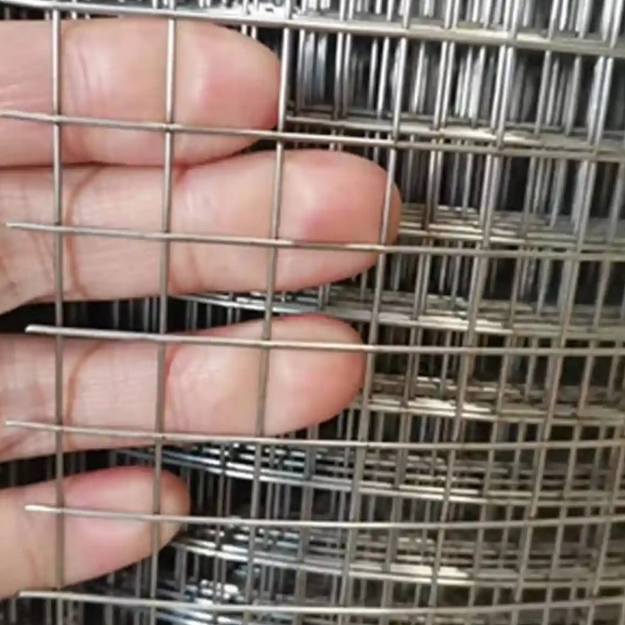
Industrial specifiers often require unyielding rigidity. Welded Wire Mesh answers this demand perfectly. It delivers robust performance in static, load-bearing environments.
High shear strength and impact resistance: The fused intersections handle extreme blunt force without collapsing.
Zero "racking" or shifting: Wires remain firmly in place under localized pressure. The grid shape never distorts.
Clean, flush surfaces: Welded panels lack the overlapping bumps seen in interlaced materials. This flush surface suits automated processing machinery and heavily sanitized hygienic environments.
Brittle weld joints: Severe, continuous mechanical vibration causes fatigue failure. The static joints eventually fracture under relentless shaking.
Inability to adapt to severely uneven terrain: Installers struggle to force rigid panels over steep, rolling hills during fencing applications.
Many critical infrastructure projects demand these specific physical attributes. Buyers primarily procure welded formats for heavy-duty applications.
Security fencing and perimeter defense: High-security facilities rely on rigid barrier panels.
Machine guards and heavy-duty shelving: Warehouse safety systems use strong panels to protect workers from moving parts.
Concrete reinforcement: Builders use thick-gauge welded panels as reliable rebar alternatives for flatwork.
Animal enclosures: Zoos and agricultural centers build pens requiring massive push-resistance from livestock.
Many contractors mistakenly try to force welded panels across undulating ground. They attempt to bend the entire panel framework. This places extreme stress on the welds. Always step the panels downward in sections when navigating steep grades.
When an application requires continuous motion or precise separation, engineers pivot their strategy. They specify Wire Mesh formed on industrial looms. The interlaced structure offers unique mechanical benefits.
Precise filtration ratings: Manufacturers weave exceptionally fine micron ratings. This achieves highly precise particle separation.
Dynamic flexibility: The material easily conforms to irregular shapes. It effortlessly wraps around custom contours and uneven topography.
Vibration absorption: The unfused joints absorb continuous mechanical vibration. They handle shaking screens without fracturing.
Cut edges can unravel: Installers must carefully manage exposed borders. The material requires edge-capping, tack welding, or structural folding during fabrication.
Prone to dimensional distortion: Heavy, localized point loads will separate the interlaced wires. Particles bypass the mesh if gaps widen.
Commercial buyers leverage this flexibility across several massive global industries. The dynamic nature of interlaced wire solves distinct engineering challenges.
Industrial filtration: Chemical processors utilize fine weaves for sieving and complex particle separation.
Architectural facades: Designers use flexible mesh for exterior decorative paneling and sunscreens.
Agricultural fencing: Farmers unroll long, continuous barriers over undulating, hilly terrain.
High-temperature processing belts: Food manufacturing relies on woven belts to handle extreme oven temperatures without snapping.
Always utilize heavy-duty perimeter frames when mounting interlaced panels for filtration. Proper tensioning prevents the center from sagging. A sagging center dramatically reduces particle separation accuracy.
Procurement teams must evaluate exact project parameters before issuing purchase orders. Analyzing the distinct differences between both manufacturing styles clarifies the decision process. We have structured this comparison across three critical engineering dimensions.
Evaluation Dimension | Welded Format | Woven Format |
|---|---|---|
1. Load Profiles & Rigidity | Exceptional for static loads. Highly rigid and resistant to blunt impact. Fails under constant dynamic vibration. | Ideal for dynamic loads. Flexes safely under continuous vibration. Distorts easily under heavy static point loads. |
2. Fabrication & Cutting Realities | Features drop-in panel cutting. Creates minimal material waste. Edges do not fray or require tension framing. | Requires strict framed containment. Cut edges instantly unravel. Labor-intensive edge-capping is mandatory. |
3. Filtration vs. Open Area | Restricted to larger open areas. Manufacturing electrodes require physical clearance space between wires. | Achieves extremely tight tolerances. Supports high mesh counts for micro-particle retention. |
Engineers strictly evaluate static versus dynamic loads. Welded formats easily win on static point-load rigidity. They endure heavy impacts without separating. However, woven construction easily wins in dynamic, vibrational environments. Shaking screens and industrial sifters destroy rigid welds over time. You must match the material to the physical motion of the operational environment.
Workshop processing dictates massive portions of project labor. Welded panels allow for fast, drop-in cutting. Technicians slice the material with minimal waste. The rigid joints guarantee zero edge-fraying. Woven rolls demand entirely different handling. You cannot simply cut an interlaced roll and leave the edges bare. It immediately unravels. Installers must apply tensioning rigs or build framed containment borders. This increases secondary fabrication time.
Process engineering relies on precise particle retention. Interlaced wire successfully achieves tighter tolerances. Looms pack filaments tightly together for high mesh counts. Conversely, heat fusion strictly restricts your options. The welding electrodes require specific physical clearance during manufacturing. Therefore, automated welders only produce grids with larger open areas. You cannot order micro-filtration panels using heat-fused joints.
Sloppy specifications lead to instant project delays. Procurement professionals must clearly define multiple technical variables. Misunderstanding these parameters causes massive headaches upon delivery.
You must accurately define the exact Mesh Count. This metric represents the number of holes per linear inch. Next, strictly specify the Wire Diameter, which indicates material thickness. You use these two specific numbers to calculate the exact Open Area percentage. The Open Area dictates the maximum flow rate for air, water, or particulate matter. Never guess these variables.
Selecting the wrong alloy invites aggressive corrosion. Understand the difference between Galvanized Before Welding (GBW) and Galvanized After Welding (GAW). GBW leaves the burned weld joints completely exposed to rust. GAW seals the entire grid in protective zinc. For harsh chemical environments, always specify 304 or 316 Stainless Steel. High-grade stainless resists pitting in marine and acidic environments. Note all corrosion risks at intersection points if improperly specified.
Industrial materials must meet rigorous global standards. Verify your selected materials against specific operational codes. Filtration systems generally require adherence to distinct ISO standards. This ensures micro-particle retention guarantees. Conversely, concrete reinforcement and load-bearing panels require strict ASTM structural codes. Falling short of these benchmarks creates massive liability.
Never place a massive commercial order blind. Always request detailed Material Test Reports (MTRs) from your supplier. These documents prove the exact chemical composition of the steel. We also recommend requesting structural sample panels. Engineers should physically test these samples before you authorize full-scale commercial runs.
Making the right material selection drastically reduces project risks and maintenance failures. Here is your final verdict matrix for procurement:
Choose welded construction for establishing structural boundaries, ensuring static rigidity, and simplifying flat-panel fabrication.
Choose woven construction for achieving precise industrial filtration, adapting to severe terrain topography, and utilizing continuous-roll flexibility.
Always verify chemical composition to match the exact corrosive threats of your installation environment.
Consult with a dedicated engineering specialist before finalizing your purchase orders. Utilize technical specification calculators to perfectly match your target wire diameter and precise mesh count. Proper alignment ensures complete environmental compliance and maximizes structural longevity.
A: Material cost-effectiveness depends heavily on volume and fabrication requirements. Woven rolls typically cost less per square foot during high-volume production. However, cut edges unravel, requiring expensive secondary framing. Welded panels cost slightly more upfront but save immense labor during fabrication because they require zero edge containment.
A: Yes, you can bend it safely using proper press-brake techniques. However, resistance welds have distinct physical limits. Bending the material exactly on the weld joint can fracture the fusion. Always apply mechanical bends on the straight wire sections located between the intersecting joints.
A: Expanded metal is slit and stretched from one solid steel sheet. This produces a rigid, durable matrix with absolutely zero material waste. It offers high structural integrity similar to welded panels but lacks the micro-precision filtration capabilities found in interlaced wire looms.
A: Woven rolls perform far better on uneven terrain. The interlaced joints allow the entire grid to "rack" and dynamically conform to rolling hills. Conversely, fixed rigid panels cannot bend along slopes. Installers must awkwardly step rigid panels downward, leaving large gaps beneath the fence.


