
- All
- Product Name
- Product Keyword
- Product Model
- Product Summary
- Product Description
- Multi Field Search
English


| Quantity: | |
|---|---|


Hexagonal stone cage net cage: multidimensional innovative solution for flexible ecological engineering
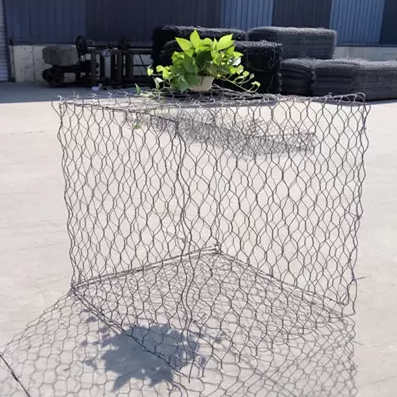
As a carrier of technological innovation in the field of ecological protection, hexagonal gabion cages are woven into rectangular cage frames using twisted hexagonal steel wire mesh, and an adaptive protection system is constructed by filling natural stone materials. Its core design breakthrough is reflected in the principle of mechanical equilibrium - the hexagonal grid structure realizes uniform stress transmission, combined with 245g/m ² high zinc layer galvanized steel wire or PVC composite coating, it can still maintain durability for more than 50 years in extreme environments such as salt corrosion and humidity. Laboratory tests show that it can withstand a pressure of 500kN/m ² without deformation, and its performance far exceeds traditional concrete protective structures.
Three core value systems
Ecological permeability characteristics: With a porosity of over 35%, natural seepage channels are formed, effectively reducing static water pressure. In river bank protection projects, soil erosion can be reduced by 80%, while alleviating urban waterlogging problems, making it the preferred solution for flood control.
Modular rapid deployment: Standardized units (such as 1m ³ and 2m ³ cubes) support prefabricated production, with an on-site assembly efficiency of 50m ³/day/team, shortening the construction period by more than 40% and significantly reducing overall costs.
Landscape integration capability: Open grid and local stone filling create natural textures, and can be customized with PVC coating colors such as matte gray and desert gold, or use 316 stainless steel material to adapt to special environments such as cold regions and coastal areas, achieving seamless integration of engineering facilities and ecological landscapes.
Typical Engineering Practice
River ecological restoration: The Rhine River cascade gabion net cage revetment project uses a three-level buffer zone design to resist the century old flood peak, while cultivating more than 20 native aquatic plants, forming a biodiversity corridor.
Transportation infrastructure: Reinforced gabion cages are used along the Qinghai Tibet Railway to construct slope protection in freeze-thaw zones, maintaining structural stability at extreme low temperatures of -40 ℃, and achieving the goal of "engineering ecology" through vegetation restoration.
Urban Public Space: The New York High Line Park innovatively applies stone cage cages to landscape seating and artistic partitions, and its integrated design of industrial aesthetics and ecological functions has won the ASLA Annual Award.
Technical iteration direction
Intelligent monitoring integration: Built in fiber optic sensors achieve real-time stress monitoring, combined with AI algorithms for structural health warning, improving the safety factor of large-scale protective engineering.
Bioengineering integration: Developing nutrient soil filling formulas and mixing technology with local plant seeds to construct self-healing ecological slopes, achieving a 30% increase in vegetation coverage in the management of the Loess Plateau.
Circular economy path: Adopting recycled aggregates and biodegradable coating technology to promote the development of stone cage cages towards zero carbonization throughout their entire lifecycle, in compliance with EU green building certification standards.
Hexagonal stone cage cages are evolving from a single protective function to a three in one solution of "protection ecology landscape" through interdisciplinary innovation in materials science, structural engineering, and ecology, continuously leading the sustainable development practice in the global ecological engineering field.
Hexagonal stone cage net cage: multidimensional innovative solution for flexible ecological engineering
As a carrier of technological innovation in the field of ecological protection, hexagonal gabion cages are woven into rectangular cage frames using twisted hexagonal steel wire mesh, and an adaptive protection system is constructed by filling natural stone materials. Its core design breakthrough is reflected in the principle of mechanical equilibrium - the hexagonal grid structure realizes uniform stress transmission, combined with 245g/m ² high zinc layer galvanized steel wire or PVC composite coating, it can still maintain durability for more than 50 years in extreme environments such as salt corrosion and humidity. Laboratory tests show that it can withstand a pressure of 500kN/m ² without deformation, and its performance far exceeds traditional concrete protective structures.
Three core value systems
Ecological permeability characteristics: With a porosity of over 35%, natural seepage channels are formed, effectively reducing static water pressure. In river bank protection projects, soil erosion can be reduced by 80%, while alleviating urban waterlogging problems, making it the preferred solution for flood control.
Modular rapid deployment: Standardized units (such as 1m ³ and 2m ³ cubes) support prefabricated production, with an on-site assembly efficiency of 50m ³/day/team, shortening the construction period by more than 40% and significantly reducing overall costs.
Landscape integration capability: Open grid and local stone filling create natural textures, and can be customized with PVC coating colors such as matte gray and desert gold, or use 316 stainless steel material to adapt to special environments such as cold regions and coastal areas, achieving seamless integration of engineering facilities and ecological landscapes.
Typical Engineering Practice
River ecological restoration: The Rhine River cascade gabion net cage revetment project uses a three-level buffer zone design to resist the century old flood peak, while cultivating more than 20 native aquatic plants, forming a biodiversity corridor.
Transportation infrastructure: Reinforced gabion cages are used along the Qinghai Tibet Railway to construct slope protection in freeze-thaw zones, maintaining structural stability at extreme low temperatures of -40 ℃, and achieving the goal of "engineering ecology" through vegetation restoration.
Urban Public Space: The New York High Line Park innovatively applies stone cage cages to landscape seating and artistic partitions, and its integrated design of industrial aesthetics and ecological functions has won the ASLA Annual Award.
Technical iteration direction
Intelligent monitoring integration: Built in fiber optic sensors achieve real-time stress monitoring, combined with AI algorithms for structural health warning, improving the safety factor of large-scale protective engineering.
Bioengineering integration: Developing nutrient soil filling formulas and mixing technology with local plant seeds to construct self-healing ecological slopes, achieving a 30% increase in vegetation coverage in the management of the Loess Plateau.
Circular economy path: Adopting recycled aggregates and biodegradable coating technology to promote the development of stone cage cages towards zero carbonization throughout their entire lifecycle, in compliance with EU green building certification standards.
Hexagonal stone cage cages are evolving from a single protective function to a three in one solution of "protection ecology landscape" through interdisciplinary innovation in materials science, structural engineering, and ecology, continuously leading the sustainable development practice in the global ecological engineering field.


